Englishไทย
RMA GROUP

STRATEGIC REVIEW

RMA Group — Sustainability Initiatives 2025: Strategic Review

Prepared for RMA Group Executive Leadership · March 2025

16
Countries
9,000+
Employees
146
Facilities
11
OEM Brands

Prepared for: RMA Group Executive Leadership & Internal Stakeholders

Source: 105-slide corporate sustainability deck (2025) supplemented with public corporate records

Date: March 2025

Executive Summary

RMA Group, founded in 1986 by Mark Whitcraft and led today by CEO Kevin Whitcraft, operates across 16 countries with 9,000+ employees, 58+ dealerships, and 146 facilities. The group distributes 11 OEM brands and spans automotive distribution, vehicle modification and defense, engineering (Comin Asia), food franchises (Express Food Group), financial leasing, and energy services.

The 2025 sustainability deck maps diverse regional programs to a common UN SDG vocabulary. The initiatives fall into four strategic clusters:

👥

People — Workforce wellness (READ), vocational education (Ford Class TVET, Cambodia VTET), safety management, gender inclusion

⚙️

Products & Services — Reusable steel packaging (RSR) replacing wooden KD kit crating, cobot automation, 3D-printed tooling

Energy — Solar installations across Thailand, Cambodia, South Africa, and Myanmar (budgeted); mains-water purification in Türkiye

📊

Governance — Digital quality assurance (EFG / NIMBLY), BSC tracking, quarterly metric reporting

This report synthesizes the deck's content by geographic region, surfaces what the deck omits, flags slide-level quality issues, and closes with strategic questions for leadership.

Background Bridge: What the Deck Does Not Tell You

The sustainability presentation opens cold — no founding narrative, no leadership introduction, no corporate scale. The following milestones, absent from all 105 slides, are essential context for any reader unfamiliar with RMA Group:

Founding & origin

1986 (RM Asia H.K. Ltd, 1985); Mark Whitcraft supplied US infrastructure to SE Asia

Cambodia entry

1992 — among the first foreign companies post-conflict; Ford distributor since 1997

Leadership

CEO Kevin Whitcraft (son of founder); SVP Christian Wiedmann; Group CFO Harjeet Drubra; advisory board includes Peter Fleet (former Ford Asia Pacific head)

Defense legacy

45,000+ security vehicles delivered to US Army TACOM for Afghanistan

Vehicle modification

750,000+ vehicles delivered globally; five modification centers (Türkiye, Dubai, SA, Australia, Thailand ADC 90,000 m²); Ford Qualified Vehicle Modifier for Asia Pacific; Kia Special Vehicles global agreement

Express Food Group

The Pizza Company, Texas Chicken, Swensen's, Dairy Queen, Boost Juice, Kamu — across Cambodia, Laos, Myanmar. The deck mentions EFG only for digital auditing (slide 105)

Cambodia bond listing

April 2020 — USD 20M corporate bonds on CSX (first private non-financial issuer); 5-year, 5.5% coupon, CGIF-guaranteed. 2024 Cambodia revenue ~USD 400M; profit after tax ~USD 16.6M

Full OEM portfolio

Ford, JLR, JCB, Fuso, John Deere, Mitsubishi, Mahindra, Kaiyi, Chery, Kia (defense), Mercedes-Benz (modification)

Recommendation: A one-page corporate profile should precede the sustainability content in any future version of this deck to anchor stakeholders who are not intimately familiar with the group's scale and history.

Global Presence

Stylized operational footprint (approximate positions). Thailand (HQ) highlighted.

Thailand
Cambodia
South Africa
Australia
Türkiye
USA

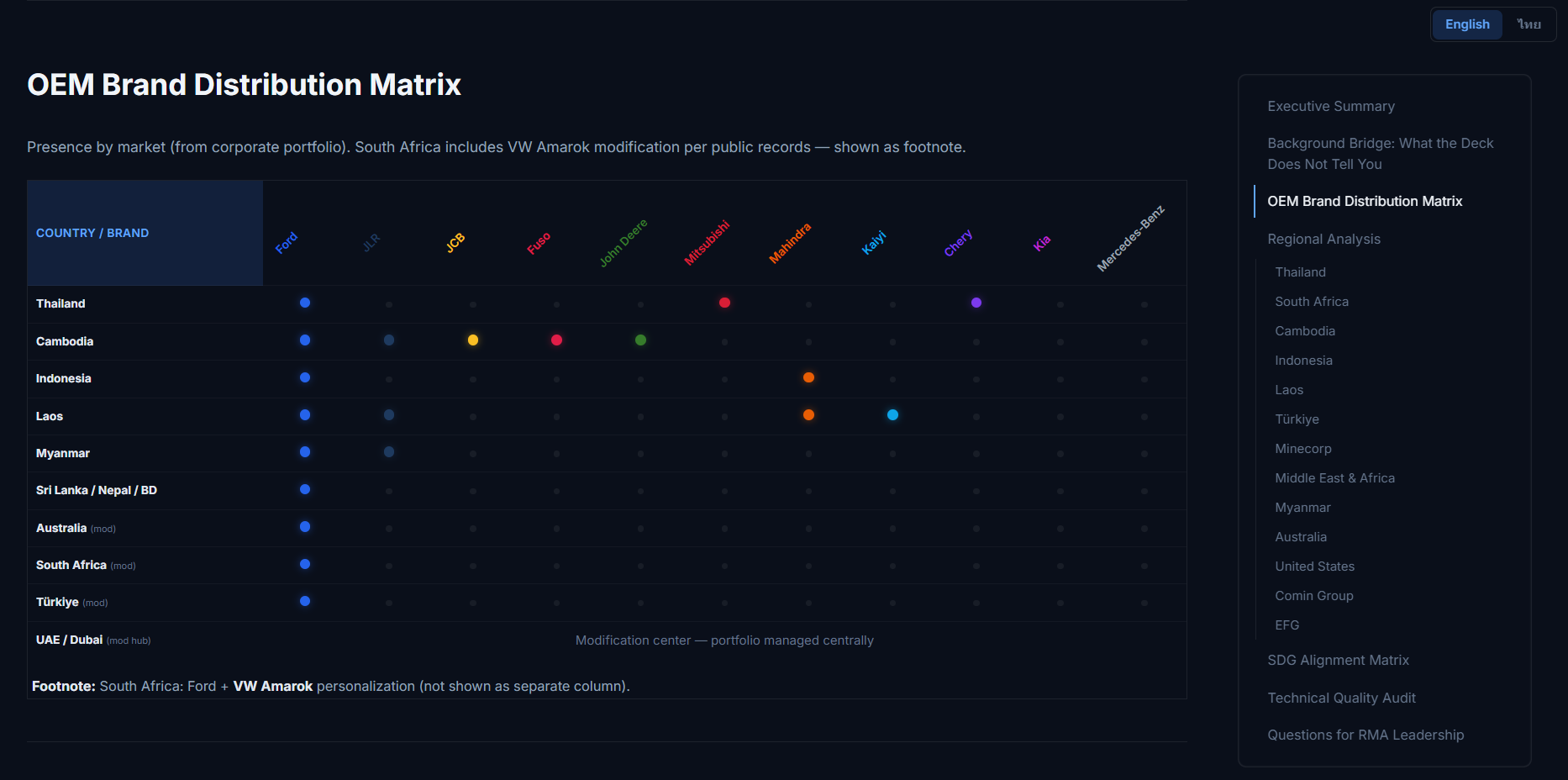
OEM Brand Distribution Matrix

Presence by market (from corporate portfolio). South Africa includes VW Amarok modification per public records — shown as footnote.

Country / BrandFordJLRJCBFusoJohn DeereMitsubishiMahindraKaiyiCheryKiaMercedes-Benz
Thailand
Cambodia
Indonesia
Laos
Myanmar
Sri Lanka / Nepal / BD
Australia (mod)
South Africa (mod)
Türkiye (mod)
UAE / Dubai (mod hub)
Modification center — portfolio managed centrally

Footnote: South Africa: Ford + VW Amarok personalization (not shown as separate column).

Regional Analysis

Thailand Hub — ADC, READ & Packaging Revolution4 entities

Entities covered: RMA Automotive Co., Ltd. · RMA Special Vehicles · RMACM & RMAT (IMD) · GFSTH

Thailand is the deck's center of gravity, consuming roughly 40 slides across four entities. Three flagship initiatives dominate, plus distribution and agriculture arms.

READ Program (SDG 3) — Relaxation, Exercise, Attitude, Diet

The READ wellness initiative, running since before 2022, is the flagship people program at the 90,000 m² Automotive Design Centre (ADC). Activities span meditation, yoga, Tabata, Pilates, nutrition workshops (led by Peter Lawson), and CSR events (mangrove planting with ~70 staff, blood donation, beach cleanup, Foundation Day merit-making). Business impact — stated on the deck:

RMA Automotive (slides 45, 51):

Metric2021202220232024Stated Change
Annual attrition rate17%11.67%12.67%10%"7.02% drop"
Engagement score68767893"15 increase"

RMA Special Vehicles (slide 73):

Metric20242025Target
Attrition rate10%7.6%
Engagement score8484+"better result"
What RMA should know: The arithmetic on slide 45 is wrong — 17% → 10% is a 7 pp drop (not 7.02%), and 68 → 93 is +25 (not +15). On slide 51, the bullet "15% increase" refers to 2023 → 2024 engagement (78 → 93) and is arithmetically consistent; it does not fix the slide 45 error for the 2021→2024 span. Slide 51 text says "17.02%" while the chart shows "17%". Automotive and Special Vehicles report READ separately with different baselines and metrics — this should be consolidated into a single group KPI view. The engagement "score" is referenced both as an integer and as a percentage in different places — standardize the unit.

Solar Energy (SDG 7)

Solar panels commissioned June 2025 at ADC. Total investment: THB 20,000,000.

The quarterly table below is taken as printed on slide 55 (RMA Automotive). Slide 56 is a Q3 update with different electricity, solar kWh, savings THB, and payback (e.g. Q3 electricity 1,808,137 THB, solar totals through Q4 541,400 kWh, savings total 2,707,000 THB, payback 4.38 years). Slide 76 (Special Vehicles branding) repeats the same template but again with different projected figures than slide 55 or 56 — the deck therefore carries multiple versions of the same solar economics grid, not a single authoritative row set.

MetricQ4 2024Q1 2025Q2 2025Q3 2025Q4 2025 (proj.)Total
Electricity spend (THB)1,532,0231,539,6861,651,0201,800,0001,800,0006,522,729
Solar generation (kWh)78,300234,900234,900313,200
Savings (THB)00391,5001,174,5001,174,5001,566,000
  • Projected payback: 4.26 years
  • Q2 energy balance: 78.3 MWh solar (41%) vs. 113 MWh grid (59%)
  • Production increase driven by Golf Buggy paint shop (oven heating)
  • Deck proposes additional panels for 2026 (highlighted in red on slide 56)

Payback: 4.26 years | Investment: THB 20M

What RMA should know: Solar was commissioned mid-year so only 6 months of data exist. The unit "Cost per kW/hr" is summed across quarters (total = 20 on slide 55) which is meaningless as a rate — fix the template. Slide 75 is the group SDG three-pillars overview, not solar economics. Slide 74 is a high-level narrative (~950,000 KW/yr, THB 4.7M) under SV branding — not the same as the quarterly table. Slide 76 mirrors the slide 55/56 layout but with different numbers; treat consolidated reporting as a data governance issue, not merely "duplicate slides."

Reusable Steel Racks — RSR (SDG 12)

The RSR program replaces wooden KD kit packaging on SKD1 shipments to Cambodia. Two snapshots exist:

MetricAs of 30 June 2025As of 30 September 2025
Volume shipped2,940 kits4,764 kits
Total savings$817,320$1,324,392
Wood avoided882,000 kg1,429 tons
CAPEX (unchanged)$591,453$591,453

2.2× ROI in 9 months

10 RSR types implemented (Ranger Cabin + Bumper, P Box, Engine, Rear Axle, Front Axle, Rear Seat, Wheels, Fuel Tank, EV Cabin, Frame). Highest per-kit saving: EV Cabin at $56/kit.

Forward plan: 6 additional RSR types (768 units total), targeting ~12,000 tons wood / 900 trees. Ford SKD2 proposal under discussion — Ford to pay for rack supply on a chargeable basis.

What RMA should know: RSR is the highest-ROI initiative in the entire deck — $591K CAPEX generating $1.3M+ savings in 9 months. The business case for accelerating the remaining 6 RSR types and expanding to other country shipments is strong. Slides 57–58 and 77–82 duplicate this content under Automotive vs. Special Vehicles branding — consolidate.

RMACM & RMAT (IMD) — Thailand Distribution

Ford (RMACM) and Mitsubishi (RMAT) distribution arms track monthly financial KPIs (Plan/Actual/Gap in KTHB) across nine projects, aligned to SDGs 3, 7, 12. Dense tracker on slide 85 with Thai KPI names and PM assignments. This section demonstrates operational integration of sustainability into distributor performance reviews.

GFSTH — John Deere Agriculture Partner

Three sustainability initiatives under GFSTH:

#InitiativeKey Metrics
1Precision farming / AutoTracFarmer input savings ~8%, productivity +14%; $40K wholesale campaign budget; 5040D demo unit at LCB port
2Big Data Management (GFS/Group IT/JDAP)RPM tracking and training investment
3Employer of ChoiceHealth, education, workplace culture under SDGs 3, 4, 8, 16

Daily activities: power saving, waste separation, printing reduction, weekly talks, quarterly all-team meetings.

What RMA should know: GFSTH's SDG headers all say "SDG 17" while covering 8, 9, 12, 13 — template issue. SDG 9 text has "Infrastructor" typo. The precision farming angle is unique in the deck and could be a differentiating ESG story for the agriculture vertical.

South Africa — RMAA SA (Slide 40 Focus)RMAA SA

Operational Resilience — Load Shedding & Solar (SDG 7)

South Africa's "Load Shedding" (forced power outages from Eskom's national grid) makes on-site solar generation a business-continuity necessity, not merely an environmental initiative. RMAA SA's solar system performance through Q3 2025:

MetricQ1Q2Q3Q42025 Total
Solar generation (kWh)3,6173,2444,15211,013
% electricity from solar71.1%60.6%56.8*65.9%
Tariff correction savingsN/AN/AN/AN/A

*Q3 cell on slide 40 reads 56.8 without a % symbol; 65.9% is as printed for the annual column.

The facility derived two-thirds of its electricity from solar, with Q1 peaking above 71%. The declining percentage through the year likely reflects seasonal variation (Southern Hemisphere winter = less sun in Q2/Q3).

65.9%
Solar

Packaging Recycling (SDG 12)

MetricQ1Q2Q3Q42025 Total
Kits shipped in recycled packaging1,1083533901,851
Cost savings (USD)$35,223$11,626$12,471$59,320

Q1's disproportionately high kit count (1,108 vs. ~370/quarter after) warrants investigation — was this a backlog clearing or a reporting artifact?

Strategic Partnerships (not in deck)

RMAA SA operates vehicle personalization and modification services specifically for Ford and Volkswagen Amarok in the South African market. This is one of five global modification centers but receives zero coverage in the sustainability deck.

What RMA should know: The business impact text on slide 40 is literally truncated — the sentence about load shedding ends mid-word. The "Tariff correction savings" row shows N/A for all quarters — either the metric is not applicable or data was never entered. The slide lists SDGs 7, 9, 12, 13 under an "SDG 17" header. South Africa's solar story is arguably the most compelling in the deck (energy = survival, not just savings) but it's given only one slide. Ford/VW Amarok modification services should be connected to the sustainability narrative.

Cambodia — Financial Hub & Assembly Operations2 entities

Entities covered: RMAA Cambodia · RMA Cambodia

Cambodia is the group's second-largest market by revenue (~USD 400M in 2024) and hosts three parallel sustainability tracks plus a major financial milestone the deck omits entirely.

300 kW Solar Roof Installation (SDG 7)

Project completed and handed over on 29 August 2025.

ItemBudget (Q1)Actual (Q1)
Solar rooftop system$283,600$93,588
License fee & related$2,000

Next steps: extend solar to CAMCO factory; monitor cost-saving correlation. Comin Asia executed the installation as the group's clean energy integrator.

Cobot Sealant Automation (SDGs 8, 9, 12, 13)

Collaborative robot for windshield/rear glass sealant application.

ItemBudgetActual Q1Actual Q2
Cobot / robot sealant cell$300,000$68,565$68,565
Installation & training$8,000$1,614

At Q2 2025: 70% complete. Delayed 2 weeks vs. original schedule due to border closures affecting shipping; further delays suspected. Rescheduled to first week of September. AGV project on hold until Q4 2025.

What RMA should know: The cobot table header says "Goal: Clean Energy" while the initiative is cobot automation — template copy-paste error. The border delay narrative mentions "boarder" (sic) twice. The $137K actual spend (Q1+Q2) against a $308K budget suggests the project is ~45% spent at 70% completion — track closely.

VTET Technical Training (SDGs 4, 8, 10, 12)

Ford & John Deere branded vocational pipeline:

MetricQ1Q2Year Total
Investment donated (USD)8,64013,68022,320
Training hours3,4566244,080
Students educated243862
Students hired by RMA21113
Wages earned by hired students$1,500$8,250$9,750

Business impact: creates a pipeline of skilled technicians while establishing the Ford & John Deere brand early in the consumer marketing lifecycle.

Financial Milestone (absent from deck)

In April 2020, RMA (Cambodia) PLC listed USD 20M in corporate bonds on CSX — the first private non-financial institution in Cambodia to do so. 5-year maturity, 5.5% coupon, CGIF-guaranteed (Asian Development Bank). 2024 Cambodia subsidiary revenue: ~USD 400M; profit after tax: ~USD 16.6M.

$400M
2024 Revenue
$16.6M
Profit After Tax
What RMA should know: This bond listing is a governance and financial sustainability story that should anchor the Cambodia section. It demonstrates capital-market credibility that strengthens every other initiative's viability. The fact that it's absent from a sustainability deck is a significant narrative gap.

Indonesia — Ford Class TVET ProgramRMA Indonesia

RMA Indonesia dedicates 23 slides (7–29) to its vocational training initiative — by far the largest single thread in the deck. The program partners with Indonesian SMK (vocational high schools) to create a Ford-branded technician pipeline.

Program structure:

  • Survey phase: 8 schools surveyed (Jakarta, Bandung, Surabaya); selection criteria: public-school status, gender balance, workshop facilities, gap vs. Japanese/Ford US technology
  • Schools selected: SMK N 35 Jakarta and SMK N 5 Surabaya
  • Cohort flow: MOU/socialization → selection (~70 candidates to 22) → TVET Ford Class (in-class with Mr. Tarhadi as mentor, Next-Gen Ranger Raptor 2.0L Diesel) → 3-month internship at Ford dealers → recruitment (T&C)
  • Student requirements: SMK Negeri TKR major, 80+ avg in TKR Productive/Math/English, no subject below 75, character rules, interview, Ford training, parental consent

Cohort status:

CohortStudentsTeachersStatusInternship
Jakarta (SMK N 35)22 trainedIn-class completeTop 4 at Ford Tomang & Mampang (2 students Jan–Jun 2026, 2 students Jul–Dec 2026)
Surabaya (SMK N 5)20 enrolled5In-class Jan 2026 (26–30 Jan)Top 4 to Surabaya/Bali (TBC)

Value delivered: Students and teachers receive global Ford training, wearpack/meals/tools, train-the-trainer pathway, career pipeline. Schools receive curriculum, long-term Ford knowledge/tools/CSR access.

Media impact (by event): Jakarta MOU (slide 20): 32 news mentions, IDR 2.235B PR value, 100% positive sentiment. Surabaya MOU (slide 27): 35 media exposures, IDR 2.175B PR value, 100% positive tonality — do not merge these into one figure; they are separate ceremonies.

What RMA should know: This program has outstanding storytelling depth but occupies 22% of the entire deck (23/105 slides). Consider condensing to 8–10 slides and moving detailed school surveys, questionnaire dashboards, and exam result tables to an appendix. Slide 27 (Surabaya MOU) incorrectly references "SMK N 35 Jakarta" in the body heading — copy-paste error. There's no cost-per-student metric or comparison to standard dealer hiring costs — adding this would make the business case concrete.

Laos — RMA LaoRMA Lao

Single initiative: replacing ~800 plastic water bottles/month at the Lao Ford Centre (LFC) with branded 300ml refillable glass bottles.

ProgramItems ReducedCost Saved (USD)
JLR 2024 (full year)4,800$180
Ford Prakhao 2025 (from Q2)600$32

Claimed 10% reduction in average monthly spending.

What RMA should know: The initiative is real but the financial impact is trivial ($212 total savings). The slide contains 8 typos in one page ("butalso", "dollers", "reductiion", "platiic", "consuption", etc.) — this is the highest typo density in the entire deck. The SDG descriptions are essentially filler. Consider whether this slide adds value to a board-level presentation, or whether Laos activity should be folded into a regional summary.

Türkiye — RMA AltinayRMA Altinay

RMA Altinay runs five distinct initiatives across slides 33–37 — the most diversified sustainability portfolio of any single entity in the deck.

1. Water Purification (SDGs 3, 6, 12, 13)

Mains-connected purification system (12 hot/cold dispensers) replacing plastic bottled water and pet cups. Investment: $4,117. Claimed 55% cost improvement.

Cost CategoryQ2Q3Q4Total
Old system (bottles + pet bottles + pet cups)$3,169$4,932$3,832$11,932
New system (mains water + paper cups + maintenance)$424$266$491~$5,267

Reconstructed from slide 33 (European-style thousands/decimals on the slide). Quarterly "old system" figures sum to $11,933 vs highlighted $11,932 on the slide ($1 rounding).

2. Waste Recycling (SDGs 12, 13)

Cardboard, nylon, and wooden pallet recycling with revenue from sales to recycling companies.

CategoryCO₂ Reduction (kg)Revenue ($, full year)
Cardboard recycling84,0004,174
Nylon recycling93,800— (included above)
Wooden pallet recycling211,5004,876
Total~389,300$9,050

Per-vehicle cost factors documented: Wooden recycling $0.049/vehicle, Cardboard & Nylon $0.021/vehicle.

3. Gender Inclusion (SDGs 5, 8, 10)

Increasing women in production from 0% (2024) to 20% target. Company-wide starting point: 5%.

PeriodTargetActual
2024 starting5%
Q1 20257%7%
Q2 202510%12%
Q3 202515%11%*
Q4 202520%

*Q3 missed target (red-flagged on slide with asterisk, but no footnote explains why).

4. Layout Optimization & Line Balancing (SDG 12)

Facility redesign: buffer area expanded from 1,750 m² to 4,300 m² (+146%), vehicle capacity from ~70 to ~160 (+129%), new 500 m² warehouse added. Hours/Option improved from 2.0 (Q4 2024) to 1.3 (Q3 2025).

Claimed improvement: 30% (in the callout) vs. 20% (in the Business Impact text) — contradiction on the same slide.

5. 3D-Printed Tooling (SDG 9)

In-house additive manufacturing of jigs, fixtures, and custom tools:

MetricValue
H1 2025 cost savings$23,500
Projects using 3D printing24
Total jigs/parts produced105 items
Equivalent market cost (€)€21,650 / ₺960,394
Vehicle platforms coveredV363, V710, J74
What RMA should know: Altinay is the most initiative-dense entity in the deck and the only one with both manufacturing efficiency AND social inclusion programs. However, slide 35's "Initiatives" header still reads "Recycling cardboard boxes" despite the content being about gender inclusion — copy-paste error. The 20% vs. 30% efficiency contradiction on slide 36 must be clarified. The CO₂ reduction numbers (389K kg total) are meaningful but lack a baseline — what's the facility's total carbon footprint?

Minecorp (Australia)Minecorp

Two-column slide (39) with parallel initiatives:

Packaging Material Reduction (SDGs 9, 12, 13):

MetricQ1Q2
Hours of labour reduced00
Labour saving ($)00
Packaging materials reduction ($)0$5,000

Young Endeavour Program (SDGs 9, 10, 4, 5): Family-and-friends sourcing of school leavers for manufacturing work experience in QLD.

MetricStartingQ1Q2
New young students onboarded457
Cross-skilled throughout Minecorp442
What RMA should know: Packaging reduction is showing zero labour impact through Q2. The Young Endeavour program is showing growth (4 → 5 → 7 students). Body copy has typos: "procut", "utilisatio", "candidiates". Small-scale but potentially replicable model for other modification centers.

Middle East & Africa — RMAA MEARMAA MEA

Health and well-being focused, with six tracked metrics:

MetricAnnual TargetQ1Q2Q3Total
First Aid training2 emp/year22
HSE training for managers3 emp/year33
Random medical checkups2/year33
Medical devices & equipment4/year1113
Mental health activities4/year112
Climate change training1/year11
What RMA should know: This is a low-investment, compliance-oriented program. The "Firts" (sic) Aid typo is on the slide. SDG header says 17 while showing SDGs 4, 8, 10, 12.

Myanmar — Vocational & EnvironmentalRMA Myanmar

Vocational Training Support (SDGs 4, 8, 5, 3)

MetricBudget (Full Year)Actual Q1Actual Q2Actual Q3Actual Total
Investment donated for training$1,000$250$0$250
Training hours800000
Students educated80000
Students hired into RMA20801 (Q3)9
Graduates hired after training (per slide row)80000
Wages earned$16,000$1,000$0$1,000

Slides 97–98 also budget 80 "graduates hired after training" with zero actuals through Q3; actual wages total stays $1,000 while hires rise to 9 — an on-slide reconciliation gap.

Q2 stalled due to the Mandalay earthquake (closed 1 EFGM store) and low turnover in RMAS service teams. Budget revised from Q1.

Reducing Environmental Impact (SDGs 3, 12, 13, 7)

MetricBudget (Full Year)Actual Q1Actual Q2Actual Q3Actual Total
Bio diesel B20 (liters)1,50030100200330
Paper waste (kg)1,600
Plastic waste (kg)2,000
Paper printing reduction35%3%4%3%10%

Q3 achievements: vinyl upcycling into tote bags/laptop sleeves/pouches; Recyglo waste bins deployed (indoor and outdoor). Next steps: "Green Office Challenge", repurpose old banners/uniforms, solar budget proposals for 5 facilities (JD Yangon, Mandalay, CML, Ford Yangon, ATC Warehouse).

What RMA should know: Myanmar is the weakest performer against targets — 0 students educated vs. 80 budgeted, biodiesel at 22% of target, paper reduction at 29% of target. The earthquake is a force majeure, but the structural question is whether the vocational pipeline has demand even without disruption. Waste mass tracking (paper/plastic kg) shows zero actuals through Q3 despite the recycling bins deployment — measurement gap. The solar budget proposals for 5 facilities could be significant if funded.

Australia — RMAA AustraliaRMAA Australia

Safety Management System with four KPI categories tracked monthly (2024 vs. 2025):

Category2024 YTD (full year)2025 YTD (through mid-year)Trend
Near Misses / Hazards1812↓ Improving
Lost Time Incidents30✓ Zero
Medical Treatment32↓ Improving
First Aid1212→ Flat
What RMA should know: Zero lost-time incidents YTD is a standout result. First Aid incidents are flat year-over-year and spike in March and May — investigate root cause. The slide only shows data through ~Q3; later months show zeros which may be unreported rather than incident-free. Aligned to SDGs 3, 4, 5, 8 — the SDG 5 (Gender Equality) alignment is not explained on the slide.

United States — GFS (USA)GFS USA

"DRIVE Your Health" wellness initiative (Diet, Recovery, Intentional movement, Vitality, Emotional well-being). SDGs 3 & 8.

MetricBaselineQ2Q4
Initiative feedback survey participation61%
Group health activity participation100%82%
Employee engagement (health & safety)58n/an/a
Team effectiveness score3.2/5n/an/a

Q3–Q4 activities: step challenges, wellness coaching collage, participant quotes, recipe and inner peace programming. Survey delayed. Slide 94 adds narrative participation stats (e.g. activity challenge registration 96%, retention 85%, overall 82% of 28 employees, recipe challenge 29%, inner peace 14%) that do not appear in the summary metrics grid on slides 92/95.

What RMA should know: The metrics table is mostly "n/a" and "TBC" — this is the least data-rich section in the deck if only slides 92/95 are read. Group health activity hit 100% in Q2 but dropped to 82% in Q4 — investigate whether this is seasonal or engagement decay. The DRIVE acronym maps well to READ (Thailand) but there's no cross-regional branding or methodology sharing documented.

Comin Group — Clean Energy IntegratorComin

Group-wide solar transition metric tracking across multiple properties:

MetricQ1Q2Q3Q4Total
Solar production (kWh)124,830186,180317,620628,630
CO₂ reduction (kg)52,17977,823132,765262,767
Cost savings (USD)$18,506$27,555$47,008$93,069

628,630 kWh total

Properties listed: Comin Khmere HQ, Mercedes-Benz Cambodia, RMA Automotive Thailand, FCC Angkor, RMAA Cambodia.

What RMA should know: Comin Asia is the group's engineering-procurement and renewable energy division led by Ivan Keogh, but the deck presents it as just a metrics table. Comin executed the Cambodia solar installation and likely influences solar strategy across the group. Its broader scope (built environment, energy-saving lighting, full lifecycle solutions) is invisible. This is a strategic asset that should be positioned as the group's sustainability infrastructure backbone, not a single data slide.

EFG — Express Food GroupEFG

SMART AUDITING via NIMBLY digital quality assurance platform:

MetricQ1Total
Office supplies cost savings$2,197$2,197
Audit checks completed18,05318,053
Training cost savings$1,786$1,786
Online learners651651

Only Q1 data populated; Q2–Q4 empty.

What RMA should know: EFG operates The Pizza Company, Texas Chicken, Swensen's, Dairy Queen, Boost Juice, and Kamu across Cambodia, Laos, and Myanmar — a major consumer-facing business with significant supply chain, waste, packaging, and labor implications. The deck mentions EFG only for digital auditing. Food-service sustainability (sourcing, packaging waste, food waste, labor practices) is a massive ESG domain that is completely absent. The slide's carnival-event photos have no apparent connection to the auditing narrative. This is the biggest content gap in the entire deck.

SDG Alignment Matrix

Coverage by operating company (UN SDG official colors). Cells indicate goals referenced in entity narrative.

Entity34567891012131617
RMA Automotive TH
RMA SV TH
RMAA SA
RMAA Cambodia
RMA Indonesia
RMA Lao
RMA Altinay
Minecorp
RMAA MEA
RMA Myanmar
RMAA Australia
GFS USA
Comin
EFG
GFSTH

Technical Quality Audit

The deck contains systematic quality issues that undermine credibility in board-level or external communications.

SDG Header Mismatches

A pervasive template error: the section header reads "SDG 17 covered by the Initiatives" while the actual SDG tiles below show unrelated goals. Affected slides:

SlideEntityHeader SaysActual SDGs Shown
40RMAA SASDG 177, 9, 12, 13
41RMAA MEASDG 174, 8, 10, 12
43RMAA CambodiaSDG 176, 7, 9, 12
44RMAA CambodiaSDG 178, 9, 12, 13
87GFSTHSDG 178, 9, 12, 13
88GFSTHSDG 178, 12
97RMA MyanmarSDG 174, 8, 5, 3
99–100RMA MyanmarSDG 173, 12, 13, 7
103CominSDG 176, 7, 9, 12
104RMA CambodiaSDG 174, 8, 10, 12
105EFGSDG 179, 8, 4, 12

Root cause: Likely a shared template where "SDG 17" was a placeholder/umbrella label that was never updated per slide.

Typos and Spelling Errors

ErrorLocationCorrect Form
COMSUMPTIONSlide 58 (title)CONSUMPTION
IntiativesSlides 40, 41, 103, 104, 105Initiatives
instedSlide 57instead
dependancySlide 40 (×2)dependence
conciousSlide 40conscious
COMUNITIESSlides 47, 68COMMUNITIES
ANS (SDG 16 tile)Slides 46, 58AND
HealtySlide 33Healthy
SantationSlide 33Sanitation
cosumptionSlide 33consumption
imitativeSlide 97initiative
infrastuctureSlide 44infrastructure
imporoveSlide 44improve
boarderSlides 42, 44border
FirtsSlide 41First
scrapingSlides 62, 63scrapping

Arithmetic Inconsistencies

  • Slide 45: Attrition "17% → 10%" described as "7.02% drop" — the 0.02 is unexplained. Engagement "68 → 93" described as "15 increase" — actual delta is 25.
  • Slide 51 vs. 45: Chart labels show 17% attrition; bullet text uses 17.02% — inconsistency within the same section.
  • Slide 55: "Cost per kW/hr" total column shows 20 (sum of five quarterly 5s) — this is not a meaningful unit rate.

Duplicated Content

Slides 53–56 (RMA Automotive solar economics; 56 updates 55) and 76 (Special Vehicles) use the same table structure but slide 76 does not match slide 55/56 numerically — consolidate with a single source of truth. Slide 75 is not solar content (SDG three-pillars alignment). Slide 74 is narrative solar assumptions, not the quarterly grid. Slides 57–58 (Automotive) and 59–65 + 77–82 (Special Vehicles) repeat RSR packaging and related SDG framing under different branding. While these may represent shared programs reported by separate business units, the repetition inflates the deck. A consolidated cross-entity view would be more effective.

Truncated Text

Business Impact text is cut off on slides 40 (RMAA SA), 33 (Altinay), and 105 (EFG — sentence break between "assurance." and "enhance"). SDG description blurbs truncate on slides 43, 97, and 103. These indicate content overflow in the slide template that was not caught during review.

Deck Quality Issues by Category

51+
Issues Found

Questions for RMA Leadership

The following questions are designed to surface strategic gaps, resolve inconsistencies, and guide the next iteration of sustainability reporting.

ESG Strategy & Governance

  • The deck maps programs to SDGs post-hoc. Does RMA Group have a formal ESG framework with board-level targets, or are SDG labels applied by individual operating companies without central coordination?
  • What is the group's aggregate carbon footprint baseline, and is there a committed reduction pathway (e.g., SBTi-aligned)?
  • The "SDG 17 — Partnerships for the Goals" header appears on nearly every regional slide but is never actually discussed. Does RMA intend to report on SDG 17, and if so, what partnerships are being tracked?

Regional Operational Optimization

  • South Africa: Solar covers 66% of electricity needs. What is the roadmap to reach higher penetration — battery storage, demand management, or additional panels? What is the actual dollar value of avoided downtime from load shedding?
  • Cambodia: The 2020 bond listing and ~USD 400M revenue are absent from the sustainability narrative. Should financial resilience be integrated into future ESG disclosures as evidence of long-term viability?
  • Thailand: READ is presented separately by RMA Automotive and RMA Special Vehicles with different metrics. Should the program be reported as a single group initiative with unified KPIs?
  • Myanmar: Vocational training budgets assumed 80 students/year, but Q1–Q2 delivered zero due to the earthquake and low demand. Should targets be reset, or is the program structurally viable?
  • Indonesia: The Ford Class TVET program is the deck's most detailed story (23 slides). What is the unit economics — cost per trained technician vs. hiring cost reduction at Ford dealers?

Reporting Quality

  • The deck contains 15+ distinct typos, 11+ SDG header mismatches, and multiple truncated paragraphs. What is the editorial review process before this material reaches external audiences?
  • Solar and RSR slides overlap under Automotive vs. Special Vehicles branding, but solar financial tables on slides 55/56 vs. 76 carry different figures — which version is authoritative for group reporting? Can RSR and a single reconciled solar grid replace the duplicated slides (~15 slides)?
  • Several metrics tables have empty Q3/Q4 columns. What is the reporting cutoff policy, and can the template pre-populate "Not yet reported" to avoid ambiguity?

Strategic Blind Spots

  • Express Food Group operates major franchise brands (Pizza Company, Texas Chicken, Swensen's, Dairy Queen, Boost Juice) across three countries — yet the deck mentions EFG only for digital auditing. What sustainability initiatives exist across the food division?
  • Comin Asia is the group's clean energy integrator and engineering arm, but its slide (103) presents only a metrics table. Should Comin's role in group-wide solar deployments be explicitly credited?
  • The founding story, leadership team, and 45,000-vehicle defense heritage are entirely absent. Should a "Who We Are" section precede the sustainability content to establish credibility with external stakeholders?